I have a friend who is serving 22 years in prison for her involvement with the Earth Liberation Front http://supportmariemason.org/ . The ELF was a loosely affiliated group of people who engaged in ecotage, sabotage against forces that are understood to be destructive to our planet or the environment. In my friend's case she and her husband at the time, burned down a genetic engineering laboratory. By typical judicial standards 22 years as a harsh sentence for arson, but of course she's not in prison for arson per se, she's doing time for political arson. This type of harsh sentencing is part of what is some times called the green scare.
Now I'm not one to consider the destruction of property to be inherently violent. Yes, if you destroy something that someone else feels a great degree of ownership towards there is a sort of emotional violence. Nonetheless any political act, or action to change anything might be felt as emotional violence. The bigger issue is that fires can be dangerous, sometimes out of control, and even the best laid plans can result in someone getting killed. But no one got hurt, they were careful but they were also lucky.
She was arrested nine years after the fire, they caught her only because her former husband wore a recording device and went to talk to her about the events. He got a nine year sentence. But I just read that his sentence has now been reduced to six years, the article presumes that this was due to further cooperation with the police. http://www.clickondetroit.com/news/Judge-gives-another-break-to-man-tied-to-Michigan-State-University-arson/-/1719418/10573778/-/evn59rz/-/index.html 22 years is for not cooperating.
The system of cooperation and plea bargaining has always upset me. I watched another friend of mine get fingered for dealing drugs many years after he'd gone clean. His arrest and subsequent trial ultimately resulted in two years of probation. These outcomes also killed him. I watched as the stress of this process led him back to drugs, destroyed his marriage, and ultimately resulted in an overdose. The irony is that although he had been involved in consuming drugs with the person who framed him, he had not been a dealer at that time. This kind of plea bargaining encourages you to abandon any sense of loyalty, and even to lie.
I understand why the state has an interest in rewarding dishonesty and disloyalty. Nonetheless it makes me mad. I wish it were my friend who got a few years chopped off of her sentence. Perhaps for maintaining her integrity.
Wednesday, April 11, 2012

Sunday, April 8, 2012
Take Back the Night, Professionals, and Trayvon Martin: A discussion of theory
A young friend of mine recently went to the local Take Back the Night demonstration and march, she was disappointed by the role of the police. Her view is that the cops are a tool of oppression, and one tool of oppression can't be used in the struggle for liberation from another oppression. There is an irony in the fact that what started as women take back the night has become women take back the night with armed escorts from men. I'm sure there may have been some women police, but when I asked my friend if the entire escort was female she of course said no. The early take back the night demonstrations as I understand it were women who had become fed up with the violence of the night and took to the streets in large numbers in mutual self-defense. The last take back the night demonstration I went to, which was quite a number of years ago, at times had a feeling like a pep rally for police/feminist cooperation.
I had to agree with my friend that the police often play an oppressive role in our society. When I worked at a homeless shelter I came to know homeless people who have been beaten up by police just for being homeless. The impression that I developed while working at the shelter was that nearly all homeless people who loitered too long in the public sphere, because they don't have a private space, experience at least police harassment. We could go on with examples of how state power props up systems of oppression. Nonetheless, it's worth asking, as I did of my young friend: "do you think there is any role for individuals who specialize in the promotion of public safety, and the resolution of social conflicts. Or are such things too important to leave to professionals?"
What this gets to is the question of the expert. My friend pointed out that in Ann Arbor it seems that everyone wants to defer to the expert. It makes sense that in a university town this might be a prevalent dynamic. Here where even your cabdriver might have a PhD there is no shortage of experts. There is of course an old definition of expert, one who knows more and more about less and less. And as we learn more in one field we often assume we know less about another.
I myself suffer from this dubious malady. As a nurse practitioner, a role that is often given the unfavorable title of mid-level provider, I am a healthcare expert. In spite of additional training and experience in certain areas of medical interest I still sometimes defer to that expert class, the physicians. Healthcare of course is different than maintaining public safety and resulting social conflict. Nonetheless, my approach to healthcare is to see expertise as a set of resources that whenever possible should be shared. I try to give my patients the information I have and the perspectives I have, and then to engage them in making decisions about their care with me.
How should political decisions optimally be made? I think there is a reasonable and important distinction between governance and administration. There is an old debate between those who favor democracy, and those who believe in the ideal of the philosopher king. In the current political discourse, we might ask what role should science have in shaping political decisions? And related to this, how much should we turn over the experts? It seems to me that to begin with, the role of the expert is to provide information. There is a danger of experts being bought out, but this doesn't completely negate the value that can come from an expert. But experts don't have a monopoly on information either. And in that "more and more about less and less" sense there is a tendency for experts to lack a holistic perspective. Information gathered from whatever source should be processed through democratic participation. A truly democratic decision gives no extra weight to the expert. This point of decision-making is what can be called governance. It's not inconsistent with direct democracy for the participants to identify experts or professionals to administer the decisions that the people have made. However in this context, information must be available regarding how well administration is being carried out. In other words transparency.
In my role as a board member of the Ann Arbor People's food co-op I get to see a variant of these dynamics in action. The co-op runs by a process called policy governance. It is assumed that the board will set policy, and that an administrator will execute that policy. My opinion, which is not necessarily the opinion of the entire board, is that the place that this process breaks down the most is where transparency or feedback is lacking.
Yet a third role in my life where I struggle with challenges around democratic participation and expertise is that of a parent for better or worse I often find myself in the position of having to make decisions for my children. I do this in partnership with my partner. We try to take input from our children, and even to engage them in a consensus process, but fortunately or unfortunately we often make the decisions about aspects of my children's life. On what grounds do we claim the right to this decision-making? Presumably it's our life experience. Our life experience has made us the experts. I wonder if parenting and taking charge of the child's life doesn't promote the kind of thinking that accepts or endorses experts. One term for the attitude of an expert or an experienced individual who looks down on the views of another is patronizing. Of course this comes from the same root as parent.
Okay what about Trayvon Martin and George Zimmerman? The dynamics of oppression were clearly in play in this tragedy. Race, age and class were all significant dynamic. Mr. Zimmerman's crime included his biases around these issues. But beyond prejudice what were the other elements of his crime? He has been criticized for not listening to the police after he called them, and they told him to stop his pursuits. Is it a crime not to agree with the perspective of the police? He has been criticized for trying to take the law into his own hands. I don't think that it's inherently wrong to want to act to stop what you see as an injustice. We might sort out if pursuing someone you are suspicious of is a crime. One thing for which I have no doubt is that shooting and killing a young man is a crime. Regardless of how much cover stand your ground laws might give you in the eyes of the law, to me shooting and killing an unarmed young man is a crime. This is a crime if it's committed by of bigoted vigilante, or if it's committed by a highly professional police officer.
I'm reminded of one of my favorite cartoons. The caption reads the nonviolent police. It shows a picture of people crouched behind police cars. One of them holds a megaphone that's pointed in the direction of a house in the background. The words from the megaphone are “okay Rocky! This is the nonviolent police! We know you are in there! Come out with your hands up or we’ll start fasting!!” There is humor here because it's naïve to expect Rocky to surrender in response to a Gandhian fast. Still, I want to ask, how would we design a social mechanism, or social process to stop injustice, or crime with nonviolent methods.
Because it is said that the state claims to have a monopoly on violence, experts from the state are not totally credible agents of nonviolent methodology. I am much more hopeful that society is mobilizing the forces necessary to oppose violence against women when women march on their own terms without police escort. This does not completely negate the expert. Another friend of mine is a local legend for her accounts of times that she has encountered fights about to break out. She has found creative ways to distract and defuse, for instance asking for directions, or breaking into song. She is an expert who does training in nonviolence for the Michigan Peace Team, an organization that sends nonviolent activists to Palestine and other conflict rich areas. Sure, she is an expert, and quite good at what she does. But the most important thing she does is train others. What would the world look like if we all had the basic skill set of a well-trained nonviolent activist?
Postscript: With a neo-Nazi group now patrolling the streets of Sanford, Trayvon Martin's Hometown claiming they are there to protect white people from a "potential" race riot, a couple things need to be said. When it comes to analyzing issues involving race, class, gender, and so on, the power status of the groups involved is an essential ingredient in any worthwhile analysis. Large numbers of women marching at night make something safe that wasn't before. The action by the neo-Nazis is the exact opposite their presence on the street intimidates people who are already on the downhill side of oppression. A reasonable interpretation of their actions is that they are not there to protect white people from a race riot, but to be a lightning rod that starts one.
I had to agree with my friend that the police often play an oppressive role in our society. When I worked at a homeless shelter I came to know homeless people who have been beaten up by police just for being homeless. The impression that I developed while working at the shelter was that nearly all homeless people who loitered too long in the public sphere, because they don't have a private space, experience at least police harassment. We could go on with examples of how state power props up systems of oppression. Nonetheless, it's worth asking, as I did of my young friend: "do you think there is any role for individuals who specialize in the promotion of public safety, and the resolution of social conflicts. Or are such things too important to leave to professionals?"
What this gets to is the question of the expert. My friend pointed out that in Ann Arbor it seems that everyone wants to defer to the expert. It makes sense that in a university town this might be a prevalent dynamic. Here where even your cabdriver might have a PhD there is no shortage of experts. There is of course an old definition of expert, one who knows more and more about less and less. And as we learn more in one field we often assume we know less about another.
I myself suffer from this dubious malady. As a nurse practitioner, a role that is often given the unfavorable title of mid-level provider, I am a healthcare expert. In spite of additional training and experience in certain areas of medical interest I still sometimes defer to that expert class, the physicians. Healthcare of course is different than maintaining public safety and resulting social conflict. Nonetheless, my approach to healthcare is to see expertise as a set of resources that whenever possible should be shared. I try to give my patients the information I have and the perspectives I have, and then to engage them in making decisions about their care with me.
How should political decisions optimally be made? I think there is a reasonable and important distinction between governance and administration. There is an old debate between those who favor democracy, and those who believe in the ideal of the philosopher king. In the current political discourse, we might ask what role should science have in shaping political decisions? And related to this, how much should we turn over the experts? It seems to me that to begin with, the role of the expert is to provide information. There is a danger of experts being bought out, but this doesn't completely negate the value that can come from an expert. But experts don't have a monopoly on information either. And in that "more and more about less and less" sense there is a tendency for experts to lack a holistic perspective. Information gathered from whatever source should be processed through democratic participation. A truly democratic decision gives no extra weight to the expert. This point of decision-making is what can be called governance. It's not inconsistent with direct democracy for the participants to identify experts or professionals to administer the decisions that the people have made. However in this context, information must be available regarding how well administration is being carried out. In other words transparency.
In my role as a board member of the Ann Arbor People's food co-op I get to see a variant of these dynamics in action. The co-op runs by a process called policy governance. It is assumed that the board will set policy, and that an administrator will execute that policy. My opinion, which is not necessarily the opinion of the entire board, is that the place that this process breaks down the most is where transparency or feedback is lacking.
Yet a third role in my life where I struggle with challenges around democratic participation and expertise is that of a parent for better or worse I often find myself in the position of having to make decisions for my children. I do this in partnership with my partner. We try to take input from our children, and even to engage them in a consensus process, but fortunately or unfortunately we often make the decisions about aspects of my children's life. On what grounds do we claim the right to this decision-making? Presumably it's our life experience. Our life experience has made us the experts. I wonder if parenting and taking charge of the child's life doesn't promote the kind of thinking that accepts or endorses experts. One term for the attitude of an expert or an experienced individual who looks down on the views of another is patronizing. Of course this comes from the same root as parent.
Okay what about Trayvon Martin and George Zimmerman? The dynamics of oppression were clearly in play in this tragedy. Race, age and class were all significant dynamic. Mr. Zimmerman's crime included his biases around these issues. But beyond prejudice what were the other elements of his crime? He has been criticized for not listening to the police after he called them, and they told him to stop his pursuits. Is it a crime not to agree with the perspective of the police? He has been criticized for trying to take the law into his own hands. I don't think that it's inherently wrong to want to act to stop what you see as an injustice. We might sort out if pursuing someone you are suspicious of is a crime. One thing for which I have no doubt is that shooting and killing a young man is a crime. Regardless of how much cover stand your ground laws might give you in the eyes of the law, to me shooting and killing an unarmed young man is a crime. This is a crime if it's committed by of bigoted vigilante, or if it's committed by a highly professional police officer.
I'm reminded of one of my favorite cartoons. The caption reads the nonviolent police. It shows a picture of people crouched behind police cars. One of them holds a megaphone that's pointed in the direction of a house in the background. The words from the megaphone are “okay Rocky! This is the nonviolent police! We know you are in there! Come out with your hands up or we’ll start fasting!!” There is humor here because it's naïve to expect Rocky to surrender in response to a Gandhian fast. Still, I want to ask, how would we design a social mechanism, or social process to stop injustice, or crime with nonviolent methods.
Because it is said that the state claims to have a monopoly on violence, experts from the state are not totally credible agents of nonviolent methodology. I am much more hopeful that society is mobilizing the forces necessary to oppose violence against women when women march on their own terms without police escort. This does not completely negate the expert. Another friend of mine is a local legend for her accounts of times that she has encountered fights about to break out. She has found creative ways to distract and defuse, for instance asking for directions, or breaking into song. She is an expert who does training in nonviolence for the Michigan Peace Team, an organization that sends nonviolent activists to Palestine and other conflict rich areas. Sure, she is an expert, and quite good at what she does. But the most important thing she does is train others. What would the world look like if we all had the basic skill set of a well-trained nonviolent activist?
Postscript: With a neo-Nazi group now patrolling the streets of Sanford, Trayvon Martin's Hometown claiming they are there to protect white people from a "potential" race riot, a couple things need to be said. When it comes to analyzing issues involving race, class, gender, and so on, the power status of the groups involved is an essential ingredient in any worthwhile analysis. Large numbers of women marching at night make something safe that wasn't before. The action by the neo-Nazis is the exact opposite their presence on the street intimidates people who are already on the downhill side of oppression. A reasonable interpretation of their actions is that they are not there to protect white people from a race riot, but to be a lightning rod that starts one.
Tuesday, April 3, 2012
The End of War- a book review
When we think of ending warfare for most of us it's hard to be optimistic. As anyone in the American peace movement can tell you, the past 10 years have been very frustrating. an effort to stop the Iraq war from starting millions of people around the planet participated in the largest day of peace demonstrations ever, and yet the war still started. If the Iraq war is now over, and it's not clear that it is, this likely happened under its own weight, and not due to any efforts of the peace movement. Even the election of a Democratic Congress in 2006, and a Democratic president in 2008 were more likely window dressings then actual forces bringing the war to an end. Many of the Democrats elected in 2006 ran on a campaign of ending the Iraq war, but when there was an opportunity to withhold funds for the war the Democrats were not willing to do so. Obama ran on a campaign to end the Iraq war, but in fact the deal that resulted in the removal of US troops(with certain exceptions) from Iraq was negotiated between the Bush administration and the Iraqi government. And yet like a shell game even with the drawing down of Iraqi troops we saw a build-up in the Afghanistan war effort (also something Obama campaigned on). Meanwhile America's war technology has taken a new gruesome turn with the flourishing of the drones. In this allowing America to open up military theaters anywhere in the world with soldiers working from the comfort of their home base on American soil. If this weren't bad enough, we could be on the verge of an Iranian war, which is the candidate at the moment for the war most likely to engulf a region.
Against this backdrop it seems almost incredulous that John Horgan would declare that the end of war is not only possible but that it may be happening soon. If “the end of war” is an overly optimistic book, it's just the kind of optimism the peace movement might needs. I first heard of Horgan a couple of weeks before I ran into his book. While trying to get to sleep on an overnight Amtrak trip I was listening to a podcast of the NPR show Radiolab. The show was about whether humans could change, and included a brief segment about Horgan whose favorite question was “Do you think humans will ever put an end to war?” Through his informal surveys in various settings he finds that somewhere between 80 and 90% of the people he asks feel that there will always be wars. These figures seem to hold across a variety of demographic groups he's surveyed, including the progressive leaning congregation where he first asked the question. Horgan is not part of that 80 to 90%. When I first picked up the book I didn't make the connection with the guy interviewed on Radiolab. It was a book I was only judging by the cover. It caught my eye on the new bookshelf at our library. So I brought it home not even sure that I would read it. But once I picked it up I couldn't put it down.
This book is a simple, elegant, easy read. If you're willing to listen to someone speaking optimistically about the future of war, this book is certainly worth reading. The book starts with a review of common theories about the causes of war. These can be divided into two groups, biological theories and economic theories. Then we get to the author's own belief about the cause of war: It’s a cultural phenomenon. The book's main message is that we can change our cultural behavior of war. In making this point he suggests that in fact we are changing our war culture. The final chapter of the book, the action plan if you will, is the place where the book has some of its greatest naiveté but I think it may be the kind of naïve optimism that can change the world.
The biological argument is that humans are innately warlike. Horgan reviews the arguments that have been made regarding our innately violent tendencies. This includes primate research, and anthropological evidence. Chimps for instance have been found to engage in warlike activities. But as Horgan points out on closer examination much of this research is tainted by the presence of the researchers. For example Jane Goodall's supplying of chimps with bananas combined with the environmental pressures of shrinking territory may have led to the chimps becoming more aggressive. In fact the first account of collective violence among chimpanzees was not observed until over a decade after Goodall's arrival. The biggest case for chimp aggression probably comes from Richard Wrangham who along with Dale Peterson published a book entitled, Demonic Males. It argues that at least among male chimps and humans there is pleasure in violence. Apparently, this book is a favorite of both Hillary Clinton and Francis Fukuyama and generally popular among Washington elites. Bonobos, our other closest genetic relative are of course anything but violent and Horgan discusses them as well, the so-called hippie chimps whose slogan could be make love not war. Frans de Waal, a bonobo researcher, argues that “Wrangham has created a cartoonishly distorted picture of the (chimpanzee) species“ to quote Horgan.
Then we get to early human culture. Tribal war certainly seems to occur among pre-contact first nation peoples. According to Horgan war is certainly something seen among Neolithic people but not Paleolithic people. The Neolithic human had agriculture and thus land worth protecting. The earlier Paleolithic were strict hunter gatherers, and so were more likely to pick up and move than they would have been to fight. Among the archaeological evidence for war the oldest site that clearly demonstrates collective violence is a 13,000 year old mass grave. This was a time of transition between Paleolithic and Neolithic but most other evidence of warfare are less than 10,000 years old, clearly into the Neolithic age. The change from Paleolithic and Neolithic is not genetic but rather a cultural change.
This brings us to the economic theories about the causes of war. When humans started farming during the Neolithic age there started to be resources, land or stores of food, that were worth fighting over. So is scarcity the cause of war? Not according to Horgan. He identifies two theories of scarcity, he identifies these theories with Malthus and Marx. From the Malthus perspective the issue was that populations would grow faster than the resources needed to support them, and so scarcity would always emerge as an issue that would lead to war. From the perspective of Marx the issue is inequality. As long as there is inequality, so goes the theory, those with less will struggle against those with more. Horgan draws heavily on work of Lewis Fry Richardson which was published in 1960 by Quincy Wright, The Statistics of Deadly Quarrels to show that neither of these arguments fit the evidence of the causes of war. To the extent scarcity is an issue it seems the perception of scarcity is more important than scarcity itself. Still as Horgan puts it “many conditions appear to be sufficient for war to occur, but none are necessary."
In developing the argument that war is essentially a cultural habit, Horgan returns to the question of our biological nature, and shows that more than our aggressiveness it may be our docility that gets us into wars. Our willingness to go along, to do what we are told. But this docility is a two-edged sword(apologies for the metaphor). Muzafer Sherif conducted an experiment in the 1950s where he created conditions among two groups of boys that provoked antagonism and hostility. But the good news is the second half of his experiment created conditions where they had to work together, and their antagonisms and hostilities were replaced with friendship. A common goal or common problem can often bridge differences and bring people together. Horgan suggests two such common goals,”one is figuring out how we can all prosper in every sense - materially as well as spiritually - without you remotely damaging our planet. Another, which will help us achieve the first, is ending war."
If war is a learned cultural phenomenon that humans developed some 10,000 years ago, is it possible that we can unlearn this culture? There are ample examples of individual cultures that have turned away from aggression, sure this is hopeful, but can our culture do it? According to Horgan we may be well on our way. He analyzes wars and war deaths and sees a decline in both. The reality is that this may depend on how you read the statistics. World War II was clearly the most destructive war in human history, but wars of the 19th century killed more people than the wars of the 20th century, and so far the 21st century seems to be doing better than the 20th from this perspective. These numbers are in absolute terms, when we look at things proportionally they look even better, because the total numbers of humans have gone up.
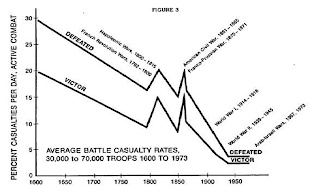
When I first heard the argument that war deaths were on the decline I found it hard to believe. So I looked at some other sources. Stephen Pinkner, a Harvard psychologist has done significant work on the decline of war. His book, The Better Angels of Our Nature, just came out in 2011. Although he relies a little too heavily on Hobbes, a worthwhile talk of his is here http://edge.org/conversation/mc2011-history-violence-pinker. Another thing I stumbled upon is the chart below. The amazing thing is that weapons have gotten far more destructive and yet daily casualty rates have dropped precipitously. Clearly there are some paradoxes here.
Of course, there are other opinions, some hold to a cyclic theory of war, and by that theory the latter 20th century, and even this first decade of the 21st century can be seen as an extended period between major wars. You can bet if there's another one it's going to be a real doozy.
There are two scenarios that could seriously reduce the trend towards a reduction in war casualties. One is a major war between major powers possibly involving nuclear weapons. The other is the violence that we might imagine could break out if environmental dynamics lead to some form of societal collapse. Regarding major wars my biggest concern is that the declining American Empire would do something stupid to try to prop itself up. This is likely avoidable, the British Empire largely walked away from its colonies. As a pessimist I think environmental collapse is likely. This could be peak oil, global climate change, or species decimation. I don't know how we will deal with these problems. As an optimist I do believe that we have the capacity to go through the environmental transformation we face and in spite of the suffering, somehow to thrive as a species.
Horgan is an optimist; he feels it that the trend away from war is likely to continue and he believes that nonviolent action is helping that process along. It is worth noting that the Soviet Union and several of its so-called communist neighbors fell under the force of nonviolence. More recently we all have reason to be excited about some of the events of the Arab spring, again nonviolent technics proved their power. Horgan is not a complete pacifist, he believes that until war is abolished there may be rules for humanitarian policing actions. Horgan proposes three rules for leaders faced with “either way you lose” choices, regarding when and how to go to war. First do no harm, by which he means don't make things worse, second minimize civilian casualties, and third consider whether it moves us closer to the larger goal of abolishing war. This of course is a completely reasonable perspective for approaching the question of when military intervention might be appropriate. And yet of course it is utter naivety to think that political leaders would agree to such rules much less follow the rules. Still demanding the completely reasonable is a good place for us to start.
There is a concern that if you say, things are getting better, people will become complacent. I think that the message we all need to give, to ourselves and to our politicians is that things have gotten better but we realize how precarious things are, and we demand that things get better still.
Against this backdrop it seems almost incredulous that John Horgan would declare that the end of war is not only possible but that it may be happening soon. If “the end of war” is an overly optimistic book, it's just the kind of optimism the peace movement might needs. I first heard of Horgan a couple of weeks before I ran into his book. While trying to get to sleep on an overnight Amtrak trip I was listening to a podcast of the NPR show Radiolab. The show was about whether humans could change, and included a brief segment about Horgan whose favorite question was “Do you think humans will ever put an end to war?” Through his informal surveys in various settings he finds that somewhere between 80 and 90% of the people he asks feel that there will always be wars. These figures seem to hold across a variety of demographic groups he's surveyed, including the progressive leaning congregation where he first asked the question. Horgan is not part of that 80 to 90%. When I first picked up the book I didn't make the connection with the guy interviewed on Radiolab. It was a book I was only judging by the cover. It caught my eye on the new bookshelf at our library. So I brought it home not even sure that I would read it. But once I picked it up I couldn't put it down.
This book is a simple, elegant, easy read. If you're willing to listen to someone speaking optimistically about the future of war, this book is certainly worth reading. The book starts with a review of common theories about the causes of war. These can be divided into two groups, biological theories and economic theories. Then we get to the author's own belief about the cause of war: It’s a cultural phenomenon. The book's main message is that we can change our cultural behavior of war. In making this point he suggests that in fact we are changing our war culture. The final chapter of the book, the action plan if you will, is the place where the book has some of its greatest naiveté but I think it may be the kind of naïve optimism that can change the world.
The biological argument is that humans are innately warlike. Horgan reviews the arguments that have been made regarding our innately violent tendencies. This includes primate research, and anthropological evidence. Chimps for instance have been found to engage in warlike activities. But as Horgan points out on closer examination much of this research is tainted by the presence of the researchers. For example Jane Goodall's supplying of chimps with bananas combined with the environmental pressures of shrinking territory may have led to the chimps becoming more aggressive. In fact the first account of collective violence among chimpanzees was not observed until over a decade after Goodall's arrival. The biggest case for chimp aggression probably comes from Richard Wrangham who along with Dale Peterson published a book entitled, Demonic Males. It argues that at least among male chimps and humans there is pleasure in violence. Apparently, this book is a favorite of both Hillary Clinton and Francis Fukuyama and generally popular among Washington elites. Bonobos, our other closest genetic relative are of course anything but violent and Horgan discusses them as well, the so-called hippie chimps whose slogan could be make love not war. Frans de Waal, a bonobo researcher, argues that “Wrangham has created a cartoonishly distorted picture of the (chimpanzee) species“ to quote Horgan.
Then we get to early human culture. Tribal war certainly seems to occur among pre-contact first nation peoples. According to Horgan war is certainly something seen among Neolithic people but not Paleolithic people. The Neolithic human had agriculture and thus land worth protecting. The earlier Paleolithic were strict hunter gatherers, and so were more likely to pick up and move than they would have been to fight. Among the archaeological evidence for war the oldest site that clearly demonstrates collective violence is a 13,000 year old mass grave. This was a time of transition between Paleolithic and Neolithic but most other evidence of warfare are less than 10,000 years old, clearly into the Neolithic age. The change from Paleolithic and Neolithic is not genetic but rather a cultural change.
This brings us to the economic theories about the causes of war. When humans started farming during the Neolithic age there started to be resources, land or stores of food, that were worth fighting over. So is scarcity the cause of war? Not according to Horgan. He identifies two theories of scarcity, he identifies these theories with Malthus and Marx. From the Malthus perspective the issue was that populations would grow faster than the resources needed to support them, and so scarcity would always emerge as an issue that would lead to war. From the perspective of Marx the issue is inequality. As long as there is inequality, so goes the theory, those with less will struggle against those with more. Horgan draws heavily on work of Lewis Fry Richardson which was published in 1960 by Quincy Wright, The Statistics of Deadly Quarrels to show that neither of these arguments fit the evidence of the causes of war. To the extent scarcity is an issue it seems the perception of scarcity is more important than scarcity itself. Still as Horgan puts it “many conditions appear to be sufficient for war to occur, but none are necessary."
In developing the argument that war is essentially a cultural habit, Horgan returns to the question of our biological nature, and shows that more than our aggressiveness it may be our docility that gets us into wars. Our willingness to go along, to do what we are told. But this docility is a two-edged sword(apologies for the metaphor). Muzafer Sherif conducted an experiment in the 1950s where he created conditions among two groups of boys that provoked antagonism and hostility. But the good news is the second half of his experiment created conditions where they had to work together, and their antagonisms and hostilities were replaced with friendship. A common goal or common problem can often bridge differences and bring people together. Horgan suggests two such common goals,”one is figuring out how we can all prosper in every sense - materially as well as spiritually - without you remotely damaging our planet. Another, which will help us achieve the first, is ending war."
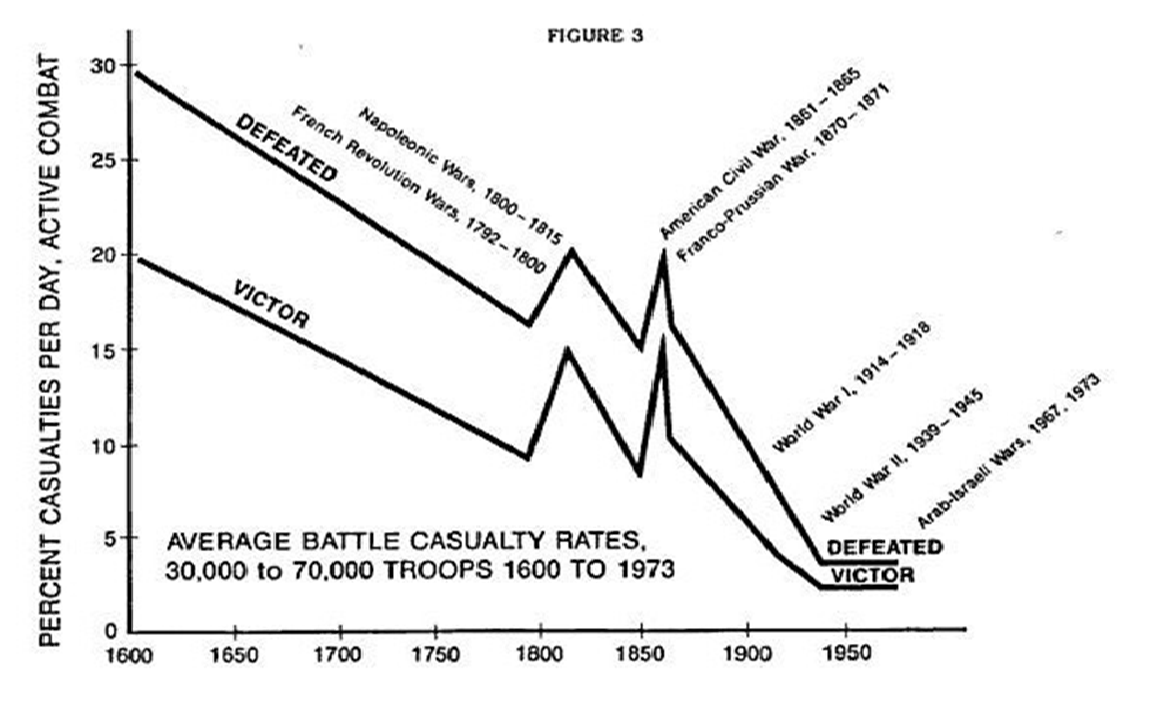
If war is a learned cultural phenomenon that humans developed some 10,000 years ago, is it possible that we can unlearn this culture? There are ample examples of individual cultures that have turned away from aggression, sure this is hopeful, but can our culture do it? According to Horgan we may be well on our way. He analyzes wars and war deaths and sees a decline in both. The reality is that this may depend on how you read the statistics. World War II was clearly the most destructive war in human history, but wars of the 19th century killed more people than the wars of the 20th century, and so far the 21st century seems to be doing better than the 20th from this perspective. These numbers are in absolute terms, when we look at things proportionally they look even better, because the total numbers of humans have gone up.
When I first heard the argument that war deaths were on the decline I found it hard to believe. So I looked at some other sources. Stephen Pinkner, a Harvard psychologist has done significant work on the decline of war. His book, The Better Angels of Our Nature, just came out in 2011. Although he relies a little too heavily on Hobbes, a worthwhile talk of his is here http://edge.org/conversation/mc2011-history-violence-pinker. Another thing I stumbled upon is the chart below. The amazing thing is that weapons have gotten far more destructive and yet daily casualty rates have dropped precipitously. Clearly there are some paradoxes here.
Of course, there are other opinions, some hold to a cyclic theory of war, and by that theory the latter 20th century, and even this first decade of the 21st century can be seen as an extended period between major wars. You can bet if there's another one it's going to be a real doozy.
There are two scenarios that could seriously reduce the trend towards a reduction in war casualties. One is a major war between major powers possibly involving nuclear weapons. The other is the violence that we might imagine could break out if environmental dynamics lead to some form of societal collapse. Regarding major wars my biggest concern is that the declining American Empire would do something stupid to try to prop itself up. This is likely avoidable, the British Empire largely walked away from its colonies. As a pessimist I think environmental collapse is likely. This could be peak oil, global climate change, or species decimation. I don't know how we will deal with these problems. As an optimist I do believe that we have the capacity to go through the environmental transformation we face and in spite of the suffering, somehow to thrive as a species.
Horgan is an optimist; he feels it that the trend away from war is likely to continue and he believes that nonviolent action is helping that process along. It is worth noting that the Soviet Union and several of its so-called communist neighbors fell under the force of nonviolence. More recently we all have reason to be excited about some of the events of the Arab spring, again nonviolent technics proved their power. Horgan is not a complete pacifist, he believes that until war is abolished there may be rules for humanitarian policing actions. Horgan proposes three rules for leaders faced with “either way you lose” choices, regarding when and how to go to war. First do no harm, by which he means don't make things worse, second minimize civilian casualties, and third consider whether it moves us closer to the larger goal of abolishing war. This of course is a completely reasonable perspective for approaching the question of when military intervention might be appropriate. And yet of course it is utter naivety to think that political leaders would agree to such rules much less follow the rules. Still demanding the completely reasonable is a good place for us to start.
There is a concern that if you say, things are getting better, people will become complacent. I think that the message we all need to give, to ourselves and to our politicians is that things have gotten better but we realize how precarious things are, and we demand that things get better still.
Sunday, March 25, 2012
Cheney's heart
Dick Cheney recently received a heart transplant. Not a moment too soon, and at least 12 years too late. Some ethicists have raised the question of whether a heart should have been wasted on a man as old as Cheney. Certainly there are younger individuals who are doing more worthwhile things with their lives (anything on the positive side of the balance sheet). Still I think it's good that he got a heart transplant. It has always been obvious that he needed one. I'm not just talking about his congestive heart failure, the failure of his heart to work as a pump. Like the Grinch it was always clear that Cheney's heart was three sizes too small.
Any heart surgery is a major operation, and a heart transplant is the ultimate cardiac surgery carries with it huge implications. While many of these implications are simply medical in nature, there is an interesting phenomenon that suggests when we transplant a heart we transplant “the heart”in both senses of the word. There are fascinating accounts of people who have had heart transplants who develop personality changes where their new personalities or traits are qualities that the heart donor had. For example someone who never liked spicy foods after receiving a new heart suddenly has a craving for spicy foods and only later learns that the donor used to love spicy foods. Sometimes the changes are as trivial as a like or a craving, sometimes their changes in mood or emotional traits.
My personal fantasy is that it could also be a change in politics. Indulge me for a second in this fantasy. Cheney gets out of recovery, and for the first time in his life he feels something that feels different to him. His heart is larger and more spacious cable to care about people he never cared about before. Struggling with this new sensation he notices that he begins to look at the world in a different way. Slowly he comes to see the ethical errors in his politics. His heart challenges him to try to make amends. He becomes confessional, insisting on telling the press the various political crimes and ethical errors he has made.
Fantasies aside, I am not a medical ethicist, I don't know if Cheney merits a new heart more than the next person on the list. I do know that on a certain level we all deserve another chance. I hold onto the belief that anyone can change. For men like Dick Cheney, change is highly unlikely. I don't know what it would take to actually change him. Perhaps something as radical as a heart transplant.
Any heart surgery is a major operation, and a heart transplant is the ultimate cardiac surgery carries with it huge implications. While many of these implications are simply medical in nature, there is an interesting phenomenon that suggests when we transplant a heart we transplant “the heart”in both senses of the word. There are fascinating accounts of people who have had heart transplants who develop personality changes where their new personalities or traits are qualities that the heart donor had. For example someone who never liked spicy foods after receiving a new heart suddenly has a craving for spicy foods and only later learns that the donor used to love spicy foods. Sometimes the changes are as trivial as a like or a craving, sometimes their changes in mood or emotional traits.
My personal fantasy is that it could also be a change in politics. Indulge me for a second in this fantasy. Cheney gets out of recovery, and for the first time in his life he feels something that feels different to him. His heart is larger and more spacious cable to care about people he never cared about before. Struggling with this new sensation he notices that he begins to look at the world in a different way. Slowly he comes to see the ethical errors in his politics. His heart challenges him to try to make amends. He becomes confessional, insisting on telling the press the various political crimes and ethical errors he has made.
Fantasies aside, I am not a medical ethicist, I don't know if Cheney merits a new heart more than the next person on the list. I do know that on a certain level we all deserve another chance. I hold onto the belief that anyone can change. For men like Dick Cheney, change is highly unlikely. I don't know what it would take to actually change him. Perhaps something as radical as a heart transplant.
Friday, March 16, 2012
Much of the news from Afghanistan of late has been about horrendous acts by US soldiers that have outraged the sensibilities of the Afghani people. While it's fair to say who wouldn't be outraged by one's country being occupied by foreign troops, these recent offenses are particularly egregious, because they are degrading to the Afghan culture, or reflect a disregard for Afghanistan lives.
America's political and military leaders and our media pundits either show shock and outrage at such behaviors as the recent massacre in Kandahar, or they insist it was an accident as in the case of the burning of Korans. In either case the messages is, “this is aberrant behavior, this is not how we train our soldiers to be.”
My response is, what do you expect? You are reaping what you sow. The military trains young men to kill, this is not an easy thing to do. I don't claim to know the psychology of this training, but once people are trained to kill should we really be surprised that they do? Specifically, that they do even when that goes against so-called rules of engagement? I would argue you cannot have it both ways. Sure, most soldiers may never commit war crimes beyond the crime of participating in war in the first place. But those soldiers such as the soldier (or soldiers) who committed the massacre in Kandahar are not psychopaths, nor are they simply fatigued troops suffering from PTSD. They are an integral part of what war is about.
If America's leaders were serious about their outrage at the Kandahar massacre they would end the war that led to it. That would be a first step towards restorative justice. I'm not holding my breath. Nonetheless a war crime has been committed, and a lesser justice at least should be pursued.
Among the Afghanis there is a call justice through Afghanistan's judicial system. Obama promises a full investigation. While I can clearly understand the desire of the people of Afghanistan to seek justice in their own ways, their judicial system is still being developed, and it is unclear what roles Islamic law and Western law play. On the other hand justice through the American military judicial system inevitably lacks at least the appearance of legitimacy.
There is a third option that I have not heard discussed. Trial in the international criminal court. This is perhaps because it is as outrageous as the notion that the people of Afghanistan should be able to seek justice for a crime committed in their country in the courts of their country. This third option would be for the Americans to turn the case over to the international criminal court. Although we are no longer signatories to the court, we still could voluntarily participate. The international criminal court is set up to prosecute individuals for four types of crimes. This massacre certainly was one of these types of crimes: crimes of war.
Granted that this option is not politically tenable at this time, we can still examine the benefits of this option. Only in examining the untenable do such things ever become possible.
The international criminal court would allow for a degree of objectivity that we cannot expect from either Afghanistan's judicial system or from the American military. If Americans want to convince the Afghanistan people that we want justice, objectivity is essential.
Perhaps more important than the specific benefits regarding US Afghanistan foreign relations, to engage the international criminal court would represent a small step by the US government towards embracing international law and the rule of law over the rule of might makes right. This small step does not commit the US to future engagement with the international criminal court although signing and ratifying the treaty that forms the international court certainly is the right thing to do.
America's political and military leaders and our media pundits either show shock and outrage at such behaviors as the recent massacre in Kandahar, or they insist it was an accident as in the case of the burning of Korans. In either case the messages is, “this is aberrant behavior, this is not how we train our soldiers to be.”
My response is, what do you expect? You are reaping what you sow. The military trains young men to kill, this is not an easy thing to do. I don't claim to know the psychology of this training, but once people are trained to kill should we really be surprised that they do? Specifically, that they do even when that goes against so-called rules of engagement? I would argue you cannot have it both ways. Sure, most soldiers may never commit war crimes beyond the crime of participating in war in the first place. But those soldiers such as the soldier (or soldiers) who committed the massacre in Kandahar are not psychopaths, nor are they simply fatigued troops suffering from PTSD. They are an integral part of what war is about.
If America's leaders were serious about their outrage at the Kandahar massacre they would end the war that led to it. That would be a first step towards restorative justice. I'm not holding my breath. Nonetheless a war crime has been committed, and a lesser justice at least should be pursued.
Among the Afghanis there is a call justice through Afghanistan's judicial system. Obama promises a full investigation. While I can clearly understand the desire of the people of Afghanistan to seek justice in their own ways, their judicial system is still being developed, and it is unclear what roles Islamic law and Western law play. On the other hand justice through the American military judicial system inevitably lacks at least the appearance of legitimacy.
There is a third option that I have not heard discussed. Trial in the international criminal court. This is perhaps because it is as outrageous as the notion that the people of Afghanistan should be able to seek justice for a crime committed in their country in the courts of their country. This third option would be for the Americans to turn the case over to the international criminal court. Although we are no longer signatories to the court, we still could voluntarily participate. The international criminal court is set up to prosecute individuals for four types of crimes. This massacre certainly was one of these types of crimes: crimes of war.
Granted that this option is not politically tenable at this time, we can still examine the benefits of this option. Only in examining the untenable do such things ever become possible.
The international criminal court would allow for a degree of objectivity that we cannot expect from either Afghanistan's judicial system or from the American military. If Americans want to convince the Afghanistan people that we want justice, objectivity is essential.
Perhaps more important than the specific benefits regarding US Afghanistan foreign relations, to engage the international criminal court would represent a small step by the US government towards embracing international law and the rule of law over the rule of might makes right. This small step does not commit the US to future engagement with the international criminal court although signing and ratifying the treaty that forms the international court certainly is the right thing to do.
Friday, February 3, 2012
an agenda for the 99%
In the wider world of course many exciting things have happened this past year. We managed to get to a handful of demonstrations against our governors attempts to usurp local democracy and break union contracts, and we’ve peripherally engaged in some of the occupy action here in Ann Arbor. Beth even got to visit Occupy Wall Street in New York, as well as Occupy Boston and Occupy Philly. I would have liked to have been much more involved in the “year of the protester.” I hope this coming year will give us all more opportunities to work for economic justice. Here is the top of my agenda:
Move to amend the constitution, we need to clarify with the constitution what should be obvious, corporations are not people, dollars are not speech. We need big money out of politics (http://movetoamend.org/).
Increase social funding from the rich, the dirty and financial speculators. The 1% do not create jobs with their excess they hoard it. Three taxes we should push for are a millionaire tax, a carbon tax and a financial transaction tax.
Increased social investment in a green infrastructure would be good for working people, good for economic growth, and good for the planet.
Demand a shorter work week. As industry continues to automate and unemployment is out of control we need to start the discussion of when and how to reduce the work week.
It’s time to end our foreign wars now. We need to address war preparation as well. With over 600 acknowledged military bases in foreign countries, and 54% of federal funds going to the military we need a plan to really cut the military and redesign foreign policy. The military doesn’t make us safer, only bankrupt.
Challenge racism and xenophobia. Divide and concur is how the 1% has always worked. Regrettably, in our subconscious, we all still carry some of this junk (https://implicit.harvard.edu/implicit/Study?tid=-1). There is still much work to do.
Shift from a corporate economy to more locally oriented and cooperative institutions. This past fall an exciting moment was when the occupy movement called on people to move their resources from the big corporate banks to credit unions. Credit unions are just one type of cooperative institution. 2012 is the UN international year of the coop. I plan to put some energy into organizing and celebrating the year of the coop (http://www.2012.coop/).
Move to amend the constitution, we need to clarify with the constitution what should be obvious, corporations are not people, dollars are not speech. We need big money out of politics (http://movetoamend.org/).
Increase social funding from the rich, the dirty and financial speculators. The 1% do not create jobs with their excess they hoard it. Three taxes we should push for are a millionaire tax, a carbon tax and a financial transaction tax.
Increased social investment in a green infrastructure would be good for working people, good for economic growth, and good for the planet.
Demand a shorter work week. As industry continues to automate and unemployment is out of control we need to start the discussion of when and how to reduce the work week.
It’s time to end our foreign wars now. We need to address war preparation as well. With over 600 acknowledged military bases in foreign countries, and 54% of federal funds going to the military we need a plan to really cut the military and redesign foreign policy. The military doesn’t make us safer, only bankrupt.
Challenge racism and xenophobia. Divide and concur is how the 1% has always worked. Regrettably, in our subconscious, we all still carry some of this junk (https://implicit.harvard.edu/implicit/Study?tid=-1). There is still much work to do.
Shift from a corporate economy to more locally oriented and cooperative institutions. This past fall an exciting moment was when the occupy movement called on people to move their resources from the big corporate banks to credit unions. Credit unions are just one type of cooperative institution. 2012 is the UN international year of the coop. I plan to put some energy into organizing and celebrating the year of the coop (http://www.2012.coop/).
Sunday, October 31, 2010
Annual Letter 2010 Halloween 10/31, Day of the Dead 11/1 (as life & politics overlap)
Dear Friends,
As many of you know I try to send an annual salutation on or around Ground hogs day. Events this year put off my late winter effort. Groundhogs day falls between the winter solstice and the equinox, Halloween is also between solstice & equinox so this year I’m writing at the other end of a cycle. Halloween is also celebrated as the Day of the Dead, an opportunity to connect with departed loved ones. So call this my “day of the dead letter”.
The great sadness in my family’s lives is the death of Beth’s father. He died on Groundhogs day February 2nd 2010. He had cancer 3 years ago which was removed followed by chemo, but about a year ago it came back. With the cancers return his options were more limited.
Beth’s father Mel was a doctor and teacher. He was passionate about many things in his world. He held professional achievements; he stood up on the good side of many issues. He defended the little guy. I know this because more than once when he felt that I was getting a raw deal he would express outrage on my behalf. He had a creative mind and was a life-long learner. But what really matters is the love you leave behind. Mel was loved by his patients, his students and others he touched. But none were touched so deeply as his family.
I am lucky to have Mel’s daughter as life partner. She is a pillar of strength and integrity, kindness and love, intelligence and humanness.
His Grandsons Zev and Teo each carry some of Mel’s beauty in them. Zev is thoughtful and engaged in the political issues of the world, he likes listening to NPR and he gets Mother Jones Magazine which he enjoys reading. Teo loves math and has recently completed the calculation of 13 factorial (that’s the multiplication of all the numbers from 1 to 13) Both boys are interested in the unanswered questions of the universe. For instance Teo is presently working on a project about black holes. Both boys find their own ways of creativity. Zev is writing a fantasy novel and has already written over 30 pages.
There were several others who’ve touched my life who died this past year, I’d like to honor them all, I’ll just mention one here. Liz Johnson was my beloved friend in Portland, one of the founders of Hei Wa house, we were activist together with the progressive student network and we worked together at the Soy Plant cooperative. She died of ALS this fall. A great sadness is that she was mother of a boy named Will who is about Teo’s age. She was an activist and a part of the cooperative movement; she worked in several collectives and workers cooperatives. All of my friends who have passed away lived good lives.
Reflecting on my own life and its purpose I have found some touch stones for now.
Last fall and winter I was looking at my many and eclectic engagements and interests I got insight into some key areas where I would like to focus my professional clinical studies and expertise. I am interested in the health implications of plant based nutrition. Eat your vegetables! I am intrigued by the question what can be done to promote longevity (hint: eat your vegetables.) I want to learn more about the health implications of environmental toxins as well as ways of helping individuals recover or maintain health in the face of toxic exposure (the broccoli family, cilantro, garlic & onions in particular). Finally, I have come to realize that I am passionate about addressing mental health issues by non-pharmacological means. That all said my main job involves a good bit of endocrinology and a lot of work with food allergies.
In January I identified some larger project oriented goals for my life in the coming year. I find that when I set clear goals that I am passionate about I tend to move forward in my life. They included: 1) a goal for professional productivity which I met before I had initially intended to, 2) running for the board of Ann Arbor’s food coop, and now I am on the board, 3) some specific markers regarding the building of my co-counseling, emotional support community, also essentially met. 4) Finishing the initial processing of a collection of over 5000 books which are becoming a peace library in a space carved out of my garage. These books belonged to Rich Ahern a friend of mine who died in 2004. This also is approaching conclusion. I had a grand opening in August and only have a few more books to go.
There was a fifth goal; I had wanted to build an extension on the back of our house with an eye to extreme energy efficiency. This will give us a larger bed room and it will allow Zev and Teo to each have their own bed room. In the end this goal has been postponed to next summer, something to look forward to.
Now let me offer some thoughts on my views of life and death in the wide world:
One area where I have been pleased with Barak Obama where he has gone farther than I thought a sitting president could go, is around the issue of nuclear weapons. Articulating a goal of a nuclear weapons free world, signing a treaty reducing the US nuclear stock pile by one third, reshaping our nuclear policy to promise no use or threat of use of nuclear weapons against non nuclear nations who are adherents to the nuclear non proliferation treaty, publicly disclosing the number of nuclear weapons we have. All of these are commendable major policy shifts unprecedented in the history of the nuclear era.
Reflecting on these actions around nuclear weapons I was emotionally moved. I remembered the many things I did during the 1980’s to oppose nuclear weapons. This was when both Barak Obama and I were young men, each in our own way shaping our political world view. As I marched, met, organized, protested, and resisted the arms race in any way I could muster Obama was exposed to the milieu that I was helping to create. I feel great pride in this, but I don’t say this to boast, rather to remember that small acts by many add together to create the context where change can happen, sometimes only by planting seeds for 25 years later.
Now back to remembering the dead: Americans continue to kill in Iraq, Afghanistan, Pakistan and Yemen. Estimated of the victims of the war on terror [or rather the war of terror] range from over 100 thousand to near one million. While most of those deaths were in Iraq, as many as twenty thousand may have been killed in Afghanistan. Those numbers will climb as long as the US is there. Mr. Obama must take responsibility for those killed abstractly, but killed in war and assassinated are two different crimes. Drones and kill lists brings the charge of assassination to the office of the president.
Trading the risk of nuclear destruction for the new weapons of the empire is not enough. I should like to plant seeds for real world peace,
The other death count we should start is that of climate change victims. The Pakistani flooding this summer had already claimed 2,000 lives by August. It’s counterpart the drought in Russia is now threatening a global food crisis. This is just the start. A UN report on probable human refugees from global warming suggests a magnitude of 700 million. That’s 1 in every 10 people on the planet!
What can we do? Many things. On an international day of action (October 10th) the participation Ann Arbor organization focused on front yard gardens (local food requires less CO2 for transportation, and what could be more local than your front yard.) I was fortunate to have a volunteer give me a hand digging up my front yard and over 100 gardens were made that day.
Ann Arbor is not the only place where gardens are a sign of hope. This summer the US social Forum was held in Detroit and Beth and I got a chance to learn about the greening of Detroit. For years Detroit had become almost synonymous with despair, post industrial decay, skyrocketing unemployment even before the recession, high crime rates. In Detroit devils’ night was the name for the night before Halloween which was known for its rampant arson, but from those ashes come gardens, hundreds of them on vacant land throughout the city, and among the gardener’s mutual aid and cooperation. Now the urban gardening movement throughout the country is looking to Detroit. From decay comes rebirth.
So amidst some sadness and loss I’d like to wish you hope and a happy Halloween.
As many of you know I try to send an annual salutation on or around Ground hogs day. Events this year put off my late winter effort. Groundhogs day falls between the winter solstice and the equinox, Halloween is also between solstice & equinox so this year I’m writing at the other end of a cycle. Halloween is also celebrated as the Day of the Dead, an opportunity to connect with departed loved ones. So call this my “day of the dead letter”.
The great sadness in my family’s lives is the death of Beth’s father. He died on Groundhogs day February 2nd 2010. He had cancer 3 years ago which was removed followed by chemo, but about a year ago it came back. With the cancers return his options were more limited.
Beth’s father Mel was a doctor and teacher. He was passionate about many things in his world. He held professional achievements; he stood up on the good side of many issues. He defended the little guy. I know this because more than once when he felt that I was getting a raw deal he would express outrage on my behalf. He had a creative mind and was a life-long learner. But what really matters is the love you leave behind. Mel was loved by his patients, his students and others he touched. But none were touched so deeply as his family.
I am lucky to have Mel’s daughter as life partner. She is a pillar of strength and integrity, kindness and love, intelligence and humanness.
His Grandsons Zev and Teo each carry some of Mel’s beauty in them. Zev is thoughtful and engaged in the political issues of the world, he likes listening to NPR and he gets Mother Jones Magazine which he enjoys reading. Teo loves math and has recently completed the calculation of 13 factorial (that’s the multiplication of all the numbers from 1 to 13) Both boys are interested in the unanswered questions of the universe. For instance Teo is presently working on a project about black holes. Both boys find their own ways of creativity. Zev is writing a fantasy novel and has already written over 30 pages.
There were several others who’ve touched my life who died this past year, I’d like to honor them all, I’ll just mention one here. Liz Johnson was my beloved friend in Portland, one of the founders of Hei Wa house, we were activist together with the progressive student network and we worked together at the Soy Plant cooperative. She died of ALS this fall. A great sadness is that she was mother of a boy named Will who is about Teo’s age. She was an activist and a part of the cooperative movement; she worked in several collectives and workers cooperatives. All of my friends who have passed away lived good lives.
Reflecting on my own life and its purpose I have found some touch stones for now.
Last fall and winter I was looking at my many and eclectic engagements and interests I got insight into some key areas where I would like to focus my professional clinical studies and expertise. I am interested in the health implications of plant based nutrition. Eat your vegetables! I am intrigued by the question what can be done to promote longevity (hint: eat your vegetables.) I want to learn more about the health implications of environmental toxins as well as ways of helping individuals recover or maintain health in the face of toxic exposure (the broccoli family, cilantro, garlic & onions in particular). Finally, I have come to realize that I am passionate about addressing mental health issues by non-pharmacological means. That all said my main job involves a good bit of endocrinology and a lot of work with food allergies.
In January I identified some larger project oriented goals for my life in the coming year. I find that when I set clear goals that I am passionate about I tend to move forward in my life. They included: 1) a goal for professional productivity which I met before I had initially intended to, 2) running for the board of Ann Arbor’s food coop, and now I am on the board, 3) some specific markers regarding the building of my co-counseling, emotional support community, also essentially met. 4) Finishing the initial processing of a collection of over 5000 books which are becoming a peace library in a space carved out of my garage. These books belonged to Rich Ahern a friend of mine who died in 2004. This also is approaching conclusion. I had a grand opening in August and only have a few more books to go.
There was a fifth goal; I had wanted to build an extension on the back of our house with an eye to extreme energy efficiency. This will give us a larger bed room and it will allow Zev and Teo to each have their own bed room. In the end this goal has been postponed to next summer, something to look forward to.
Now let me offer some thoughts on my views of life and death in the wide world:
One area where I have been pleased with Barak Obama where he has gone farther than I thought a sitting president could go, is around the issue of nuclear weapons. Articulating a goal of a nuclear weapons free world, signing a treaty reducing the US nuclear stock pile by one third, reshaping our nuclear policy to promise no use or threat of use of nuclear weapons against non nuclear nations who are adherents to the nuclear non proliferation treaty, publicly disclosing the number of nuclear weapons we have. All of these are commendable major policy shifts unprecedented in the history of the nuclear era.
Reflecting on these actions around nuclear weapons I was emotionally moved. I remembered the many things I did during the 1980’s to oppose nuclear weapons. This was when both Barak Obama and I were young men, each in our own way shaping our political world view. As I marched, met, organized, protested, and resisted the arms race in any way I could muster Obama was exposed to the milieu that I was helping to create. I feel great pride in this, but I don’t say this to boast, rather to remember that small acts by many add together to create the context where change can happen, sometimes only by planting seeds for 25 years later.
Now back to remembering the dead: Americans continue to kill in Iraq, Afghanistan, Pakistan and Yemen. Estimated of the victims of the war on terror [or rather the war of terror] range from over 100 thousand to near one million. While most of those deaths were in Iraq, as many as twenty thousand may have been killed in Afghanistan. Those numbers will climb as long as the US is there. Mr. Obama must take responsibility for those killed abstractly, but killed in war and assassinated are two different crimes. Drones and kill lists brings the charge of assassination to the office of the president.
Trading the risk of nuclear destruction for the new weapons of the empire is not enough. I should like to plant seeds for real world peace,
The other death count we should start is that of climate change victims. The Pakistani flooding this summer had already claimed 2,000 lives by August. It’s counterpart the drought in Russia is now threatening a global food crisis. This is just the start. A UN report on probable human refugees from global warming suggests a magnitude of 700 million. That’s 1 in every 10 people on the planet!
What can we do? Many things. On an international day of action (October 10th) the participation Ann Arbor organization focused on front yard gardens (local food requires less CO2 for transportation, and what could be more local than your front yard.) I was fortunate to have a volunteer give me a hand digging up my front yard and over 100 gardens were made that day.
Ann Arbor is not the only place where gardens are a sign of hope. This summer the US social Forum was held in Detroit and Beth and I got a chance to learn about the greening of Detroit. For years Detroit had become almost synonymous with despair, post industrial decay, skyrocketing unemployment even before the recession, high crime rates. In Detroit devils’ night was the name for the night before Halloween which was known for its rampant arson, but from those ashes come gardens, hundreds of them on vacant land throughout the city, and among the gardener’s mutual aid and cooperation. Now the urban gardening movement throughout the country is looking to Detroit. From decay comes rebirth.
So amidst some sadness and loss I’d like to wish you hope and a happy Halloween.
Subscribe to:
Posts (Atom)